What's happening
One company wants to own a word that a whole subculture built.
Cyberdelic Society Berlin is an independent, non-profit cultural collective — artists, technologists and psychonauts exploring where digital technology meets altered states of consciousness. It's one of several “cyberdelic” communities around the world, part of a movement that has used that name openly for decades.
In spring 2026, a US company — Cyberdelic Nexus, a Delaware LLC — filed two EU trademark applications: the “Cyberdelic Society” logo, and — nine days later — the bare word “Cyberdelic” itself, covering education, entertainment and cultural events. It has signalled it intends to stop other groups from using the name. A small non-profit can't out-spend a company in a legal fight. But it doesn't have to.
EU trademark law lets anyone tell the examiner, for free, that a word is too generic or descriptive to belong to one owner. Enough voices, and the application fails on its own merits.
What was filed
The application, on the public record.
The logo is already narrower than a word mark. The bare-word filing is the real grab — and the more clearly refusable, because a plain descriptive word has no styling to hide behind.
The receipts
“Cyberdelic” is older than the web browser.
A portmanteau of cyber + psychedelic, it has named a real cultural movement since the mid-1980s. A timeline of public, datable use — all of it long before the 2026 filing:
- 1984High Frontiers magazine launches in Berkeley (R.U. Sirius) — it becomes Reality Hackers (1988), then Mondo 2000 (1989), the glossy bible of cyber-psychedelic culture.
- 1994Timothy Leary publishes Chaos and Cyber Culture — “the PC is the LSD of the 1990s,” “turn on, boot up, jack in.” Douglas Rushkoff's Cyberia: Life in the Trenches of Hyperspace documents the same scene.
- 1995The film Hackers features a nightclub called Cyberdelia — mainstream cinema already treats the word as common shorthand.
- 1999+The word is recorded in dictionaries as ordinary descriptive English (“blend of cyber- + psychedelic”), with published usage citations.
- 2017“The Cyberdelic Society” (London) is already running public “Cyberdelics Incubator” events; its website is archived online from 2018 — over five years before the applicant's own web presence.
- 2023A peer-reviewed paper (Frontiers in Psychology) names “organizations such as The Cyberdelic Society” and its “Cyberdelics Incubator” events — describing a field, not a brand.
- 2026A Delaware company files to trademark “Cyberdelic Society” in the EU.
Every entry above is backed by a dated, citable source. The full evidence pack is part of the formal objection.
Take five minutes
File your own objection. It's free, and anyone can do it.
These are called third-party observations. You don't become a party to the case, you don't need a lawyer, and there's no fee. You're simply telling the EU examiner that the mark shouldn't be registered on absolute grounds — because the term is descriptive and customary. The more independent voices the examiner hears, the stronger the signal.
-
Open the mark on EUIPO eSearch
Go to the application's page in EUIPO eSearch — 019336948 (the logo) or 019342510 (the word). You file on each one separately. If you're prompted to sign in, create a free EUIPO account (User Area) — it takes a minute.
-
Click the real button — not the contact form
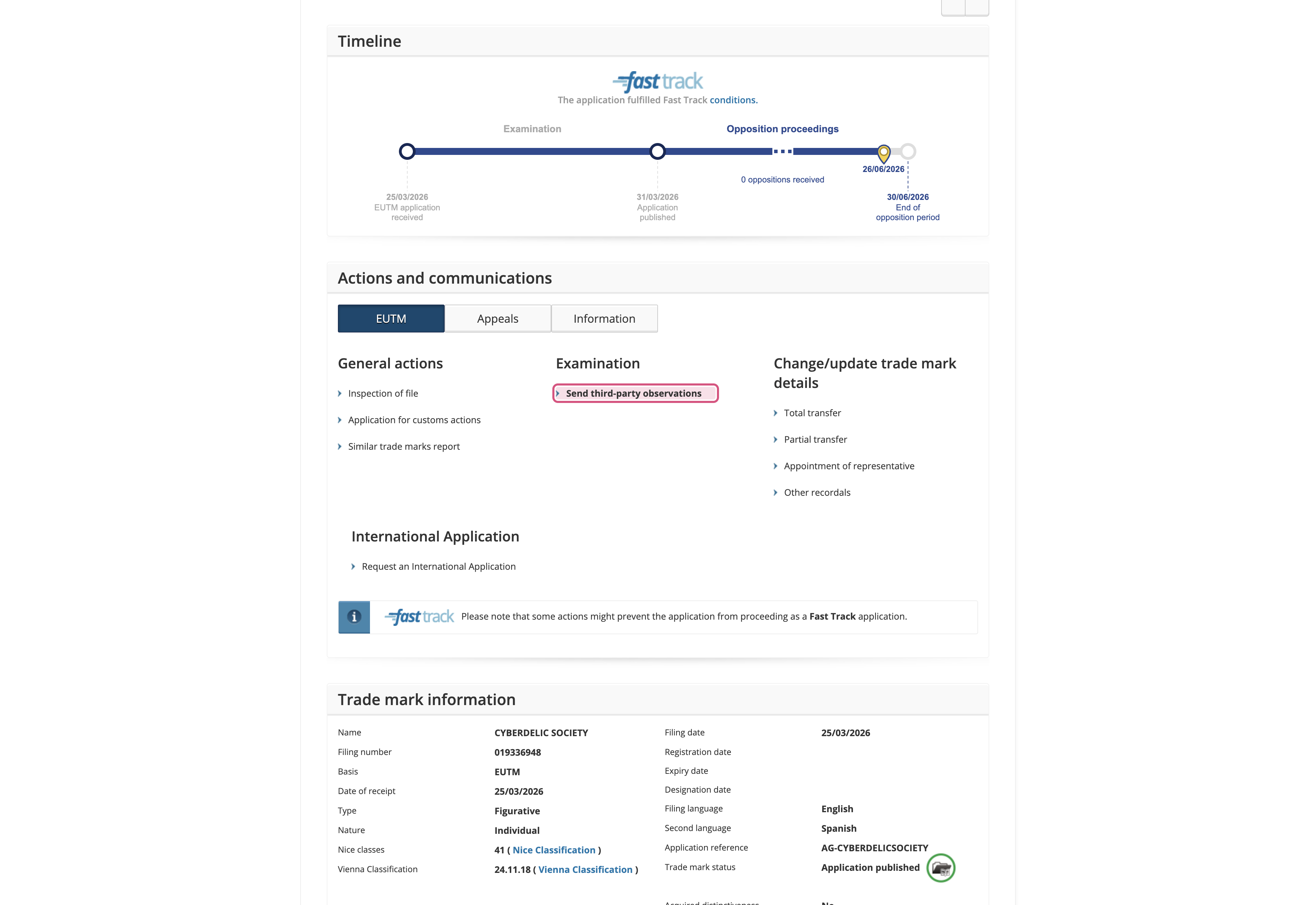
Scroll to Actions and communications, open the EUTM tab, and under Examination click “Send third-party observations.” This is the only channel that counts: observations sent through the EUIPO contact form or by email are not registered against the file — the Office confirmed this to us in writing. The screenshot below shows exactly where the button is.
-
Write your message and attach the evidence
In the Message box, say in your own words that “cyberdelic” is descriptive and customary cultural vocabulary — not one company's badge (Article 7(1)(b), (c), (d) EUTMR). Use the starter text below. Then use Add attachments for your evidence PDF — keep the filename short (about 17 characters, e.g.
OBS-019336948.pdf); the field rejects long names. Add Annex is for any separate supporting document and asks for a short description, its page count, and the page of your submission where it's cited. English, French, German, Italian or Spanish is fine. -
Sign, submit, and save the receipt
Type your name in Signature, click Continue, and submit. EUIPO generates a confirmation PDF — keep it. The logo (019336948) is in its opposition window until 30 June 2026; the word mark (019342510) is under examination now, so observations reach the examiner immediately. You won't be told the outcome, but the Office must consider the grounds you raise.
Third-party observations on EUTM application No. 019336948 ("CYBERDELIC SOCIETY") — and/or No. 019342510 ("CYBERDELIC", word mark) — Class 41, absolute grounds, Article 7(1)(b), (c) and (d) EUTMR.

"Cyberdelic" is a long-established descriptive term — a blend of "cyber" and "psychedelic" — that has named a recognised cultural and aesthetic movement since the mid-1980s (e.g. High Frontiers magazine, 1984; Mondo 2000, 1989; the 1995 film "Hackers" and its "Cyberdelia" club; dictionary entries). Applied to educational, entertainment and cultural-event services in Class 41, it directly describes the subject matter and theme of those services and is devoid of distinctive character.

"Cyberdelic Society" has also been used by multiple independent groups and is documented in peer-reviewed literature (Hartogsohn, Frontiers in Psychology, 2023) as the name of a movement running public events — i.e. it is customary in the relevant field and does not identify a single commercial origin. Registration would grant one undertaking an unwarranted monopoly over descriptive cultural vocabulary.

I therefore ask the Office to consider these absolute grounds for refusal.
Who's asking
Cyberdelic Society Berlin.
We started as a few people in Berlin in early 2025, gathering to imagine new cyberdelic experiences — VR, sound, visionary art, altered states. We grew into an independent collective and, in January 2026, formally declared our autonomy.
We're not trying to own “cyberdelic” either. That's the point: no one should. It's a commons — a word the culture made together, and one that any community should be free to use. We're asking the EU not to hand it to a single owner.